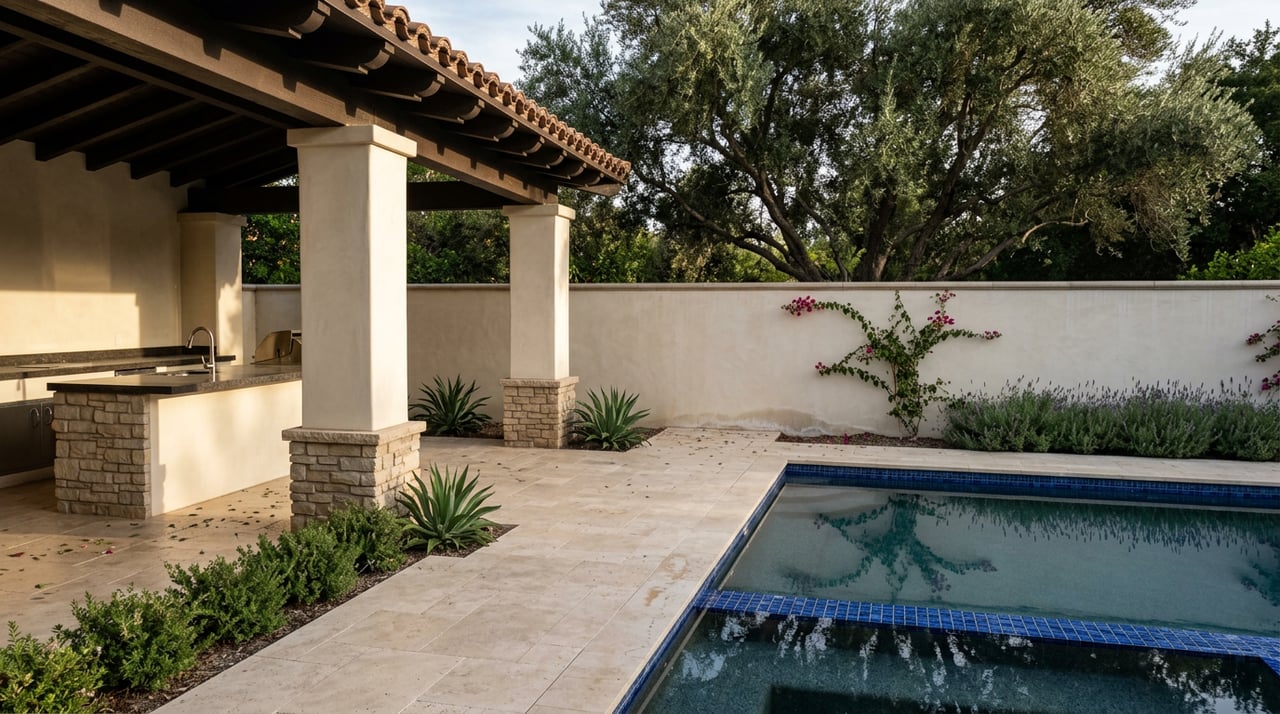
Ask anyone who has closed escrow on a bluff-top address in Del Mar what changes once the contingency period opens, and the list is almost always the same. A geotechnical report that wasn't in the original budget. A setback line that quietly eats into the buildable envelope. An insurance quote that excludes the one peril everyone assumed was covered. None of this shows up on the listing sheet. It shows up in week two of escrow, and by then the buyer has already fallen in love with the ocean air.
That friction is real, and it's localized. It applies to a specific band of Del Mar addresses, the ones sitting in or near the city's Coastal Bluff Overlay Zone, and it doesn't touch a home three blocks inland. Which means the moment you compare two Del Mar listings at a similar price, you're not just comparing square footage and finish level. You're comparing two very different relationships to risk, and in 2026, one more layer of uncertainty has been stacked on top that nobody, not even the agency running the process, can price yet.
The Line That Shows Up Before the Price Does
Del Mar administers its coastline through a certified Local Coastal Program, with the California Coastal Commission holding appellate authority over anything close to the water. Within that program sits a rule that matters more to a buyer's timeline than almost anything on the comp sheet: new development is generally kept back at least 40 feet from the edge of a coastal bluff, a threshold documented in the city's own hazard mitigation planning.
For a narrow bluff-top lot, that setback isn't an abstraction. It can shrink the usable building envelope enough to reshape a renovation plan before the first sketch is drawn. Any expansion near the edge typically triggers a fresh geotechnical study, one that models expected bluff retreat over a chosen design life of 30, 50, or even 100 years, plus a new Coastal Development Permit that can add months to a project timeline, longer if a neighbor appeals it to the Coastal Commission.
Insurance follows the same pattern. Standard homeowners policies typically exclude gradual earth movement and erosion, the exact peril a bluff-top owner is most exposed to, which means separate endorsements or specialty coverage often need to be priced out before an offer is even written. Lenders increasingly want to see a geotechnical clearance attached to the file for anything sitting close to the edge.
None of this appears in a portal search. It appears in escrow, on a subset of Del Mar parcels, which is exactly why a single blended median for the city tells a buyer almost nothing about what they're actually walking into.
A Median Built on Very Few Sales
Del Mar's overall numbers already carry a mathematical warning label. The city closes roughly 140 to 160 total transactions a year across every property type, a volume small enough that a handful of ultra-high or ultra-low sales can swing the median meaningfully in a single month. As of July 2026, the median sale price for a detached single-family home in the 92014 zip code stood at $3,825,000, up 62.8 percent year over year, according to MLS data reported through the Greater San Diego Association of REALTORS®. Inventory had tightened to just 37 detached homes for sale, months of supply had fallen to 3.9 from 6.1 a year earlier, and homes were selling at 100.3 percent of original list price, a full seven points higher than the year before.
Read those numbers on their own and Del Mar looks like a single, uniformly overheating market. It isn't. The Beach Colony, Del Mar's walkable, sand-level enclave of beach cottages and rebuilt homes directly on the Pacific, commands the highest prices in the city and the numbers show it even in the rental market, where summer racing-season rentals there range from roughly $18,500 a month for a smaller two-bedroom to $100,000 a month or more for a large oceanfront estate. Olde Del Mar, sitting just above the Colony on the bluffs, blends ocean-view estates with quieter inland streets. A 62.8 percent year-over-year jump in a market this thin is at least partly a story about which handful of homes happened to close, not a uniform repricing of every address in the city.
That's the first reason the median misleads. The second reason is bigger, and it isn't finished happening yet.
The Question the Median Can't See
Del Mar's bluffs have been eroding under the region's only coastal rail corridor for more than a century, and the agencies responsible for the tracks have known it for decades. Since 2003, SANDAG and the North County Transit District have completed four separate stabilization projects between Coast Boulevard and Torrey Pines State Beach, installing more than 230 support columns along the way. The current effort, Del Mar Bluffs Phase 5, is a roughly $88 million program running from 2024 through 2027 that adds seawalls, drainage improvements, and native replanting, and it is explicitly described by SANDAG as a short-term fix meant to hold the line for about 30 years, not a permanent solution.
The permanent solution has been on the table since 2007, when a Caltrans and Federal Railroad Administration study first recommended moving the tracks off the bluffs entirely and into a tunnel. In mid-2024, SANDAG narrowed the field to three alignments now under formal environmental review.
| Alignment | Approximate Length | What It Means on the Ground |
|---|---|---|
| I-5 | About 6.8 miles | Enters near Solana Beach, continues south beneath the Del Mar Fairgrounds through an underground special events platform, then follows the interstate east |
| Crest Canyon | About 5.3 miles | Portal near the intersection of Jimmy Durante Boulevard and Camino Del Mar, exiting near a knoll by I-5 |
| Camino Del Mar | Not yet detailed publicly | The original 2007-recommended route, running beneath the village's main coastal road |
The realignment project itself is anticipated to cost upward of $4 billion regardless of which alignment is ultimately chosen, and each option raises a different local objection. Del Mar Fairgrounds CEO Carlene Moore has publicly asked what happens to the county fair, horse racing, and music festivals if trains end up running beneath the fairgrounds property. Solana Beach Chamber of Commerce executive director Kimberly Jones has raised a parallel concern about a tunnel disrupting that city's own downtown. Del Mar's City Council, in a set of guiding principles adopted in December 2023, went on record opposing eminent domain and the placement of tunnel portals near existing homes, language that only gets adopted when residents already expect their own properties could be in the path.
Here is the part that matters most for anyone comparing two Del Mar addresses today. SANDAG released an updated Notice of Preparation for the Draft Environmental Impact Report in May 2025, and as of its most recent public update in July 2026, the project is still described as being set to enter the environmental phase, a timeline that has already slipped past the design-build target SANDAG floated back in 2024. The agency has been direct about what that means for property owners:
"A decision has not been made on which proposed alignment will be built. It is too soon to know how many homes will be impacted, and SANDAG has not reported any numbers."
That's not a caveat buried in a footnote. That's the agency running the process telling the public, in 2026, that it cannot yet say whether a given Del Mar address sits inside the footprint of a future tunnel portal, a temporary construction easement, or nothing at all. SANDAG has also noted the flip side, that a successful realignment could eventually free up land for new coastal access and recreation once the tracks are gone. The uncertainty cuts both ways. Nobody, buyer or agency, can price an outcome that hasn't been decided.
What This Actually Means Before You Write an Offer
A blended median treats every Del Mar home as interchangeable. It isn't. Some addresses carry a known, quantifiable cost today, the setback lines, the geotechnical requirements, the insurance exclusions that come with sitting inside the Coastal Bluff Overlay Zone. A smaller number of addresses, particularly those near Camino Del Mar, Jimmy Durante Boulevard, or the Fairgrounds, also carry an unresolved question about tomorrow, one that won't be answered by SANDAG for years.
None of that is a reason to avoid Del Mar. It's a reason to ask sharper questions before you're deep into a contingency period. Whether a specific parcel falls within the Coastal Bluff Overlay Zone. Whether there's a recorded geotechnical report or Coastal Development Permit history on file with the city. Whether an insurer will actually write a policy on the terms you're assuming, before you're the one holding the risk. And whether the address you're looking at sits anywhere near the alignments SANDAG is still studying, not because it changes what the home is worth today, but because it changes what you're actually signing up to hold.
This is exactly the kind of question a good local advisor should be asking on your behalf before you fall in love with a view. If you're weighing a specific Del Mar address, or trying to understand what a listing's price actually reflects once you account for where it sits relative to the bluffs, Lisa Hadzicki can walk through the comparison with you, permit history and all. Let's talk about your next move.


